


Recently, the scope of application for transparent LED display technology has expanded further, and building curtain walls are embracing new forms of visual expression. As digital content becomes more closely integrated with architectural spaces, an increasing number of building projects are focusing on how to enhance façades with dynamic visual content whilst preserving the building's sense of transparency.
The completion of numerous large-scale projects is providing fresh examples of this trend. Let us now take a look at what China's leading LED display companies have been doing.
Unilumin: Transparent LED Enters Large-Scale Building Projects
CentralWorld, Bangkok
In March 2026, Unilumin completed a transparent LED project covering approximately 2,400 square metres at CentralWorld in Bangkok, Thailand. The project utilised the UVF series of transparent screens, with a transparency rate exceeding 70 per cent, and employed installation methods such as framed curtain walls, point-supported curtain walls and suspended installations, tailored to the building's structure.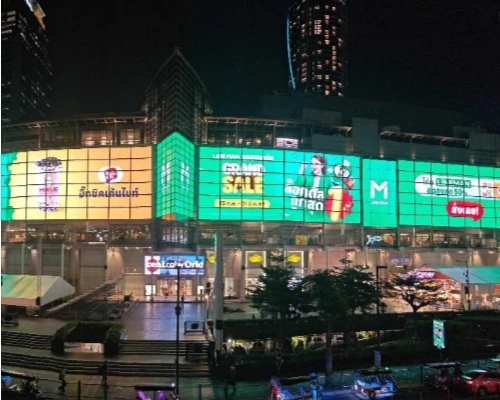
Oula Tower, Kuwait
In 2026, Unilumin completed the region's first large-scale transparent LED curtain wall at Oula Tower in Kuwait City. The screen measures approximately 52.8 m × 29 m, covering an area of nearly 1,600 m². The project utilised a transparent LED solution installed on the tower's exterior façade, achieving a maximum brightness of 10,000 nits whilst preserving the view from the interior of the building outwards, enabling the building's façade to serve dual functions as both a digital advertising medium and an architectural feature.

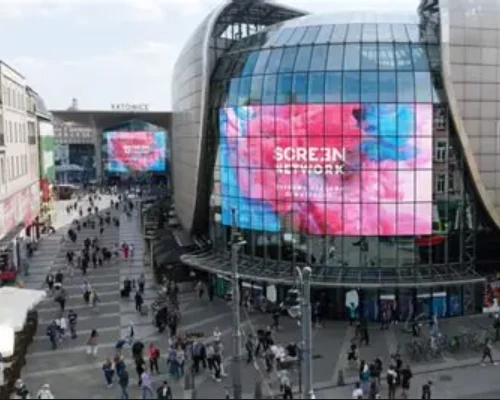
Galeria Katowicka, Poland
In Katowice, Poland, Unilumin provided a transparent LED display solution for the façade of the Galeria Katowicka shopping centre. The project covered an area of approximately 153 m² and utilised the UVF10.4 transparent LED product. Official project documentation explicitly positions this as a transparent LED installation designed to enhance the visual impact of the building's façade, whilst also increasing the building's visibility within the urban environment through dynamic content.
Transparent LED Is Becoming a New Digital Medium for Building Facades
Judging by recent overseas projects, the application of transparent LED building façades is exhibiting several notable trends.
- Firstly, project scale is expanding. From sections of commercial building façades to large-scale building curtain walls exceeding 1,000 square metres, transparent LEDs are beginning to fulfil digital media display functions across larger areas.
- Secondly, transparent LEDs are becoming more deeply integrated with building structures. Projects no longer simply involve mounting LED modules behind glass; instead, different installation methods must be selected based on the glass curtain wall, building frame and façade structure. For large-scale projects, the display effect is merely one aspect; structural safety, maintenance methods and the building's original functions must also be incorporated into the design.
- Thirdly, a balance must be struck between transparency and display quality. Greater transparency does not necessarily mean a better project. The building's location, ambient brightness, viewing distance and content type all influence the final solution. For example, high-rise buildings outdoors require higher brightness, whilst the interiors of commercial buildings may place greater emphasis on transparency and spatial visual effects. Consequently, transparent LED projects increasingly emphasize customisation tailored to the architectural environment, rather than simply applying standard products.
MileStrong also maintains a focus on the application of transparent LED technology in overseas buildings, commercial spaces and specialized structures, providing display solutions for diverse architectural contexts through its range of transparent LED products, bespoke solutions and project technical support.