

Why LED Dome Theaters Are Expanding Across Tourism, Science Education, and Entertainment
As immersive experiences continue to move into cultural tourism, science education, and commercial venues, dome theaters are evolving from a niche cinema format into comprehensive experience environments that combine LED display, spatial audio, digital content, and multi-sensory interaction.
Unlike conventional flat-screen cinemas, dome theaters use a hemispherical or spherical display structure to expand the audience's field of view. For science museums, planetariums, cultural tourism destinations, and theme parks, this format both strengthens content impact and gives venues a distinctive experience that is difficult to replicate with standard display formats.
Dome Theaters Are Moving Toward LED Display Technology
Building a dome theater is not simply a matter of bending LED panels into a curve. It requires an integrated design approach covering module geometry, steel structure, image correction, and system control - all tailored to the spherical surface.
Projects can adopt full sphere, hemisphere, or tilted sphere configurations depending on site conditions. Some large-scale installations reach sphere diameters of 5m to 50m.
On the display technology side, fine-pitch LED is becoming an increasingly important direction for dome theater applications. Products at P1.875 and P2 deliver the image resolution required for close-range viewing and support 4K and 8K ultra-high-definition content. Depending on the project environment and content requirements, dome display brightness is typically configured in the range of approximately 800–1,500 cd/m².
Compared to traditional projection dome systems, LED display offers meaningful advantages in brightness, image detail, and long-term operational stability - driving a gradual shift from projection toward LED technology across the dome theater market.
A Dome Theater Place Higher Demands on System Integration
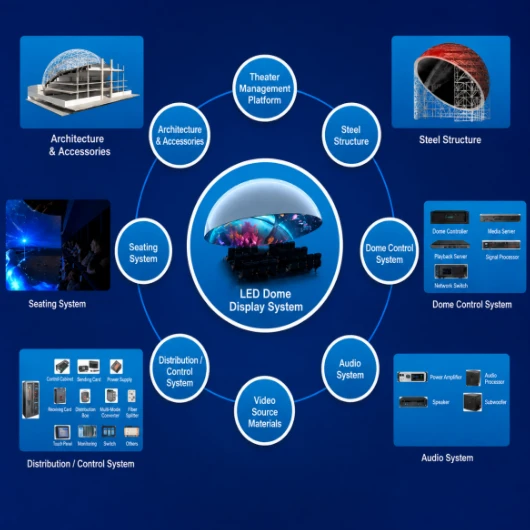
A dome theater is not a single display device. It is built from multiple systems working together.
The LED display system handles image output. The playback system manages multi-channel synchronized output, spherical image correction, and content delivery. Because a spherical surface introduces image distortion, projects typically rely on fish-eye correction, edge blending, and curved surface correction technology to ensure continuous, seamless imagery across all zones.
The audio system also needs to be designed specifically for the dome environment - using multi-channel or immersive spatial audio to keep sound synchronized with the image. For flight theater and motion theater applications, the system can be extended further with 6-degrees-of-freedom motion seats, wind effects, mist effects, and lighting systems to complete the full sensory experience.
This means the technical scope of a dome theater project has expanded well beyond LED display manufacturing - into structural design, display control, content adaptation, and full system integration.
Science, Tourism, and Entertainment Are Expanding LED Dome Applications
The value of a dome theater extends beyond screening content.
- Science museums and planetariums
The dome format transforms abstract knowledge - the universe, galaxies, Earth's geological history - into panoramic visual experiences.
- Historical Museums
Dome theaters can be built around regional culture, historical narratives, and natural landscapes to create immersive cultural experiences tied to specific places and stories.
- Theme parks and cultural tourism projects
The dome can be combined with 6-DOF motion seats, spatial audio, wind, mist, and lighting effects to deliver flight theater and immersive theater experiences.
This combination of visual, auditory, tactile, and environmental stimuli transforms the dome theater from a display device into a complete immersive experience system.
The Future of LED Dome Theaters
Looking at where the industry is heading, dome theaters will continue developing along four axes: higher image resolution, broader LED adoption, smaller footprint products, and transition from novelty attraction to sustained operational asset.
8K content and finer pixel pitch LED will further improve spherical display detail. LED dome systems are expected to replace traditional projection in more projects going forward.
At the same time, smaller-format dome products are opening up new markets - family experience centers, commercial spaces, science education facilities, and smaller cultural tourism projects that could not previously justify a full-scale dome installation.
For operators, the value of a dome theater is also shifting - from a one-time novelty experience toward a long-term operational platform capable of continuously refreshing content and adapting to different programming needs across seasons and events.
MileStrong follows LED dome applications across cultural tourism, science education, and immersive experience environments, providing flexible technical options for dome projects at different scales through fine-pitch LED display, spherical structural design, and system integration.
As LED display, digital content, and immersive interaction technology continue to converge, the dome theater is positioned to become one of the LED display industry's most significant application categories - connecting science education, cultural tourism, and entertainment experience in a single format.