


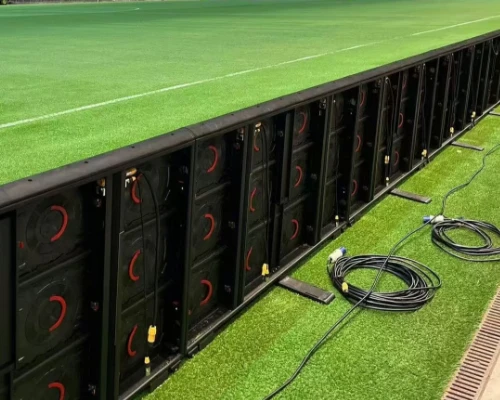
Shenzhen MileStrong Technology Co., Ltd. is one of the most reliable manufacturers and suppliers of perimeter led displays for stadiums in China. With abundant experience, we warmly welcome you to wholesale bulk perimeter led displays for stadiums at competitive price from our factory. Customized orders are welcome.
For football stadiums, basketball arenas, and multi-purpose sports venues, a perimeter LED display carries several roles simultaneously - match advertising, brand exposure, live event information, and the whole structure. Because the screens sit close to players, officials, and spectators, the requirements around safety, structural stability, refresh rate, viewing angle, and maintenance are meaningfully different from a standard outdoor billboard installation.
From the practical standpoint of a sports venue project, a LED display that genuinely fits the environment needs to answer three questions first:
- Can it be seen clearly?
- Is it safe enough?
- Can it run reliably over the long term?
What Is a Perimeter LED Display?
A perimeter LED display is installed around the area including a football pitch, basketball court, or other sports venue. It is also commonly referred to as a Stadium Perimeter LED Display, Sports Perimeter LED Screen, or Stadium LED Advertising Board.
The key difference from a traditional static advertising board is straightforward: content can be switched in real time.
Why Do Stadium LED Displays Need Specialized Design?
A standard outdoor LED billboard is typically installed on a roadside, building facade, or commercial area - with a safe distance between the screen and anyone passing by.
A sports venue is a different environment entirely.
In football, players may sprint at full speed directly toward the perimeter. In basketball, athletes operate within very close range of the court-side screens. Impact protection is therefore a design requirement for stadium perimeter LED displays, not an optional feature.
Stadium projects frequently incorporate Soft Mask, soft module protection, or protective mask designs. The purpose is to reduce the injury risk if an athlete makes unexpected contact with the LED display structure during play.
Why Does Soft Mask Matter?
Soft Mask is a detail that procurement teams frequently overlook. Conventional LED display surfaces are relatively hard. If a screen is positioned directly at the playing field boundary and an athlete collides with it at speed, the rigid structure becomes a potential hazard.
A flexible rubber protective structure gives the screen edge and surface meaningful cushioning capability. A matte surface finish also reduces ambient light reflection, making the display more comfortable to look at for both athletes and spectators.
How to Choose the Right Sports Perimeter LED Screen
Stadium perimeter screens serve the live audience - but they also appear in broadcast coverage, news footage, short-form video, and social media content. When footballers sprint, basketball players move at high speed, and broadcast cameras pan quickly, a display with insufficient refresh rate will show flicker, scan lines, or image instability on camera. High refresh rate is a standard requirement for stadium LED displays for this reason.
For pixel pitch selection, a more useful approach than looking at pixel pitch alone is to evaluate it together with three factors: viewing distance, screen size, and content type.
For brightness, the right level for a stadium LED display depends on a combination of conditions:
- Outdoor ambient light levels
- Viewing distance
- Content type
- Camera shooting requirements
- Day and night operation
For venues that host both daytime and evening events, brightness control and color calibration are equally important. Proper calibration keeps sponsor logos, team visuals, and live event content looking consistent across different lighting conditions.
The Commercial Value of Stadium Perimeter LED Displays
From an operational standpoint, the value of a perimeter LED display goes well beyond what a static advertising board can offer. A single match can be divided into distinct advertising windows:
- Pre-match: brand promotion, team information, event preview
- During play: sponsor advertising, live match data, dynamic content
- Halftime: commercial advertising, promotional campaigns, audience interaction
- Post-match: brand content, match recap, promotion of the next event
This content management flexibility makes a stadium LED display a genuine long-term digital advertising asset within the venue's commercial operations.
Which Venues Are the Right Fit?
If a project involves any of the following, a purpose-built stadium perimeter LED display is generally a better choice than a standard outdoor LED screen:
- Football stadiums - player safety, long viewing distances, and sponsor advertising all need to be addressed
- Basketball arenas - high refresh rate required, covering fast-motion content and live broadcast
- Multi-purpose venues - needs to adapt flexibly to different sports and events
- International competition venues - long-term stable operation with broadcast, branding, and commercial advertising requirements
- Commercially operated stadiums - ongoing advertising revenue generation through digital content
How to Evaluate a Stadium LED Display
When buying a stadium LED display, comparing pixel pitch, brightness, and price is not enough on its own. A more complete evaluation framework covers:
- Safety - does the design address the risk of close-range athlete contact?
- Visibility - is the image clear at different viewing distances across the venue?
- Refresh rate - is it suitable for fast-motion content and broadcast capture?
- Viewing angle - does image quality hold up across all audience zones?
- Structural design - is it built for long-term stadium installation and use?
- Maintenance - are modules, power supplies, and other components accessible for service?
- Content flexibility - can it switch quickly between match content, advertising, and brand material?
For MileStrong, the goal in a stadium LED display project is not simply to supply a brighter screen. It is to configure the right system based on the stadium layout, viewing distances, event types, content requirements, and installation conditions - so the display performs reliably during a real match, in front of tens of thousands of live spectators, and under broadcast cameras from around the world.
Hot Tags: perimeter led displays for stadiums, China, suppliers, manufacturers, customized, wholesale, price, bulk


